
Founded in 1997, RoboCup is one of the world's largest robotics and artificial intelligence competitions. It has evolved around a long-term vision: to develop a fully autonomous robot football team capable of defeating the human World Cup champions by 2050.
Football follows similar rules but tests different boundaries of capability. The World Cup challenges human physical fitness, willpower and creativity, while RoboCup continuously pushes the technological limits of robots in perception, motion and intelligent decision-making.
The sport of football is unfolding along two separate evolutionary paths for two distinct "life forms".
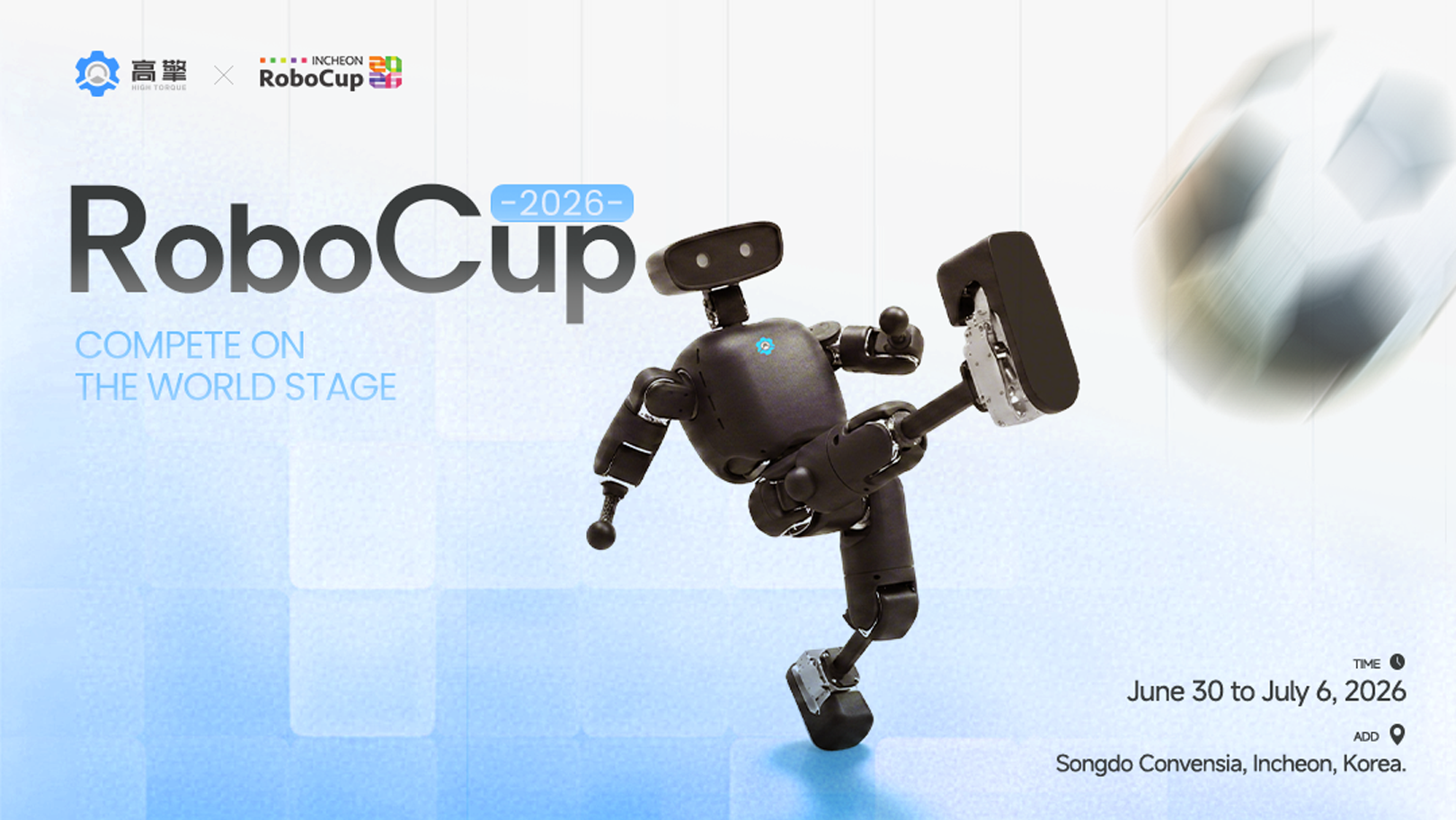
Why Football? — The Dynamic Touchstone for Humanoid Robots
Among all test scenarios for humanoid robots, football is widely recognized as the touchstone for dynamic performance. This is because it simultaneously assesses three core capabilities: real-time perception, stable motion control, and multi-agent collaborative decision-making, covering nearly the entire technical chain from robot perception to execution.
Most commercial humanoid robots today — whether operating on industrial assembly lines or providing reception services in public spaces — primarily perform static or quasi-static tasks. Their motion trajectories are relatively fixed, external environmental variables are limited, and demands on movement speed and anti-disturbance capacity are moderate.
The football pitch is the exact opposite. A rolling ball, moving opponents, and constantly shifting offensive and defensive rhythms combine to create a highly dynamic, unpredictable environment. Robots must perceive continuously, make real-time decisions and adjust rapidly while moving at high speed, with far less margin for error than in conventional application scenarios.
For humanoid robots, playing football is a full-stack engineering examination. The technical expertise accumulated through football competition forms the core competitive foundation for next-generation humanoid products. A judgment that humans make in an instant requires robots to complete a full closed loop: visual capture → target recognition → trajectory planning → joint actuation, with latency compressed to the millisecond level. Meanwhile, executing runs, shots and physical contact within the constraints of power output, self-weight and battery life is, in essence, an extreme validation of hardware capabilities.
For this reason, football has long been regarded as a centralized proving ground for humanoid robot technology. Teams that can deliver stable performance in competitive matches are better positioned to break through the boundaries of real-world deployment. For nearly three decades, this validation has taken place on one single stage: RoboCup.
The RoboCup football pitch is never an isolated technology showcase. It is a "compressed test field" for humanoid robot technology, evaluating the systematic capabilities of an entire platform across power systems, structural design, motion control and training loops.
Truly valuable capabilities do not come from single-point breakthroughs in laboratories. They emerge from continuous validation, rapid iteration and eventual consolidation into reusable platform capabilities through high-intensity competition. Following this logic, High Torque treats the football pitch as a critical validation arena for product evolution, and continuously feeds competition experience back into underlying platform design.
High Torque Mini Pi Plus: Built Precisely for Competitive Confrontation
Proven Strength Through Back-to-Back Victories
This year, High Torque has achieved landmark results in RoboCup events, and has been officially approved by the RoboCup International Board as a RoboCup League Partner. This designation recognizes the High Torque platform's high standards of stability, openness and technical maturity within the global competition ecosystem.
In March at the RoboCup German Open, the Mini Pi Plus platform powered the first Chinese team to win an international championship in the Small Size League. The ZJUDancer team from Zhejiang University competed in the Small Size division and defeated defending champion Hamburg Bit-Bots 4:1 to claim the title, breaking the long-standing dominance of traditional powerhouses from Germany, Japan and South Korea.
In April at RoboCup China, all eight quarter-finalist teams in the Small league adopted the High Torque Mini Pi Plus platform, fully demonstrating the platform's performance stability, algorithm adaptability and ecological versatility.
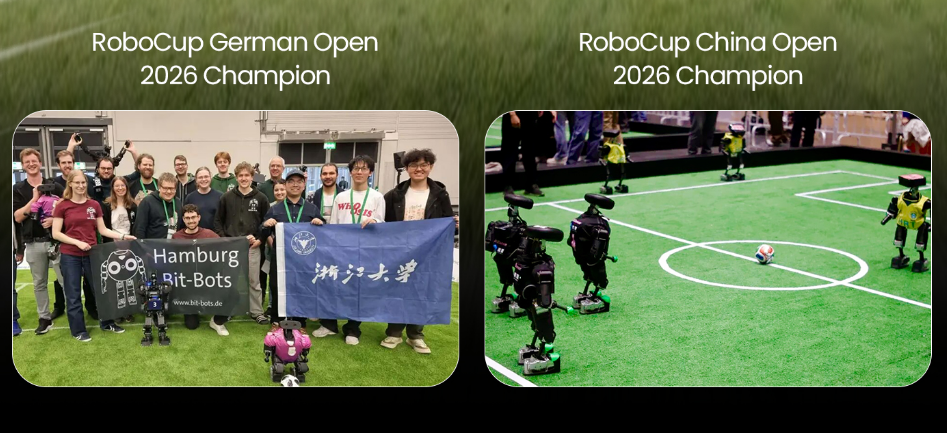
These real-world competition trials have not only confirmed the technical strength of the Mini Pi Plus platform, but also built up substantial technical and practical reserves for the upcoming Incheon World Final.
The Mini Pi Plus is engineered from the hardware level to meet the high-dynamic demands of football competition. Its 68cm-tall, 14.8kg lightweight body balances agility and stability. Equipped with self-developed high-performance joint modules, it delivers high torque and high rigidity to support fast running, sudden stops and powerful shots. It also retains a full range of motion for collision buffering, center-of-gravity adjustment and fall protection. The body is constructed from high-strength lightweight composite materials, with the center of gravity lowered to the waist-abdomen region, balancing movement speed and competitive stability while strictly controlling overall weight.
On the software and perception side, Mini Pi Plus uses robocup_workspace as its core framework, unifying the development environment and interfaces for out-of-the-box functionality. Paired with ZED Mini/RealSense cameras and an NVIDIA Jetson Orin NX main controller, it delivers efficient perception and computing support. It also integrates full-stack capabilities for motion control, visual perception, behavioral decision-making and communication coordination, and supports simulation environments including Isaac Lab and MuJoCo, enabling a complete Sim2Real pipeline from simulation training to real-robot deployment.
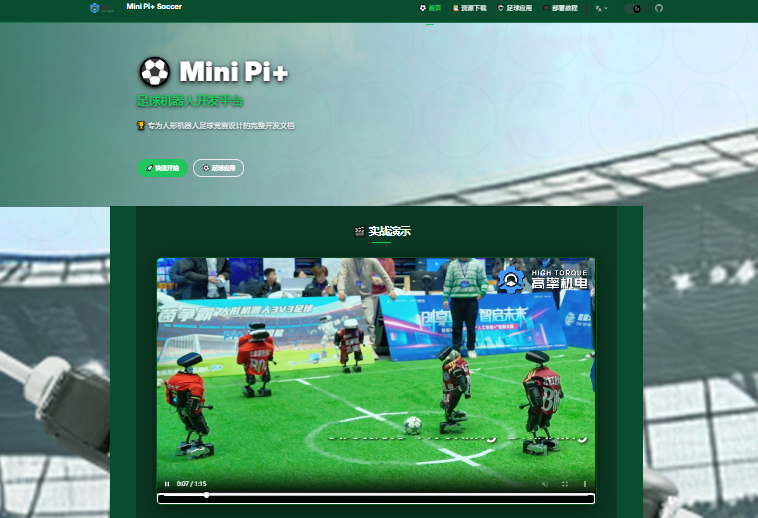
High Torque Soccer Robot Development Platform:
https://hightorque-robotics.github.io/mini-pi-soccer-docs/
Designed around developers' real workflow, High Torque has built a dedicated robot development platform for football competition, systematically integrating software capabilities, engineering expertise and teaching systems:
Full-stack technical support: A complete knowledge system covering environment setup, SDK deployment, vision systems, behavioral decision-making, motion control and other key modules.
One-click deployment: The platform provides downloadable full deployment packages, including motion control SDKs and system initialization configurations.
Engineering experience codification: Addressing the common experience gap faced by participating teams, it systematically organizes debugging workflows, key parameter logic and on-field SOPs.
From its inception, the platform has been positioned as "developer infrastructure" rather than a mere instruction manual. A strong software ecosystem reduces engineering barriers and environmental costs, allowing developers to focus their energy on strategy optimization and algorithm innovation — this is the core differentiating advantage of Mini Pi Plus within the RoboCup ecosystem.
From Competition to Industry: On-Field Achievements Drive Real-World Deployment
For High Torque, the value of RoboCup extends far beyond trophies. The true value lies in consolidating capabilities proven in high-dynamic scenarios into standardized, modular, reusable platform capabilities. High-speed motion control, whole-body coordination, low-latency perception loops, anti-disturbance balance and autonomous decision-making mechanisms honed on the pitch will eventually be transferred to a wide range of real-world applications.
From robot platforms, core joints and perception systems to control frameworks and development ecosystems, High Torque is committed to building full-stack capabilities. This allows technical experience to migrate rapidly from competitions to R&D, education, scientific research and industrial applications, accelerating the adoption of embodied intelligence in the real world. Meanwhile, small-format robots inherently offer low cost, high safety, fast iteration cycles and a more open development environment, making them ideal carriers for embodied intelligence training and application validation.
The industrialization of humanoid robots will only accelerate when more developers can enter the field with low barriers, iterate continuously, and co-build the ecosystem together.
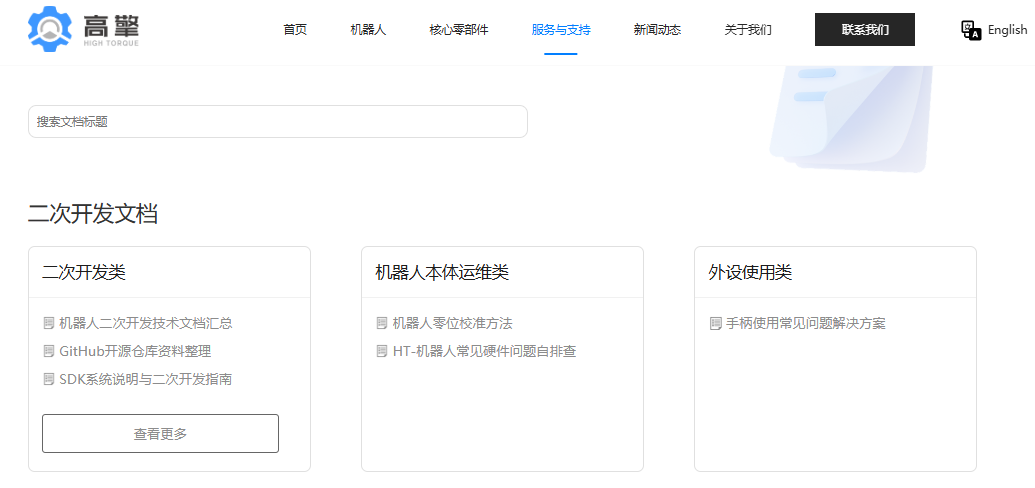
To further open up its technical capabilities and lower development entry barriers, High Torque has officially launched a full series of secondary development technical documents, with complete development and operation & maintenance materials made available simultaneously. The documentation covers all scenarios including biped robot secondary development, algorithm reproduction and scientific research operations, providing standardized technical support for university research, algorithm verification and secondary development projects.
Secondary Development Documentation Link:
https://www.hightorque.cn/docs
 Form submitted successfully!
 Form submission failed!
 Phone:400-6080-891
  Email:service@hightorque.cn
  Wechat:GQJD2022