On October 30, the 88th China Educational Equipment Exhibition opened at the Changsha International Convention and Exhibition Center. High Torque Robotics, one of the innovation forces in China’s embodied-intelligence and humanoid robot field, is presenting Mini Pi Plus at booth E3044 and has officially launched its first complete embodied-intelligence education solution — bringing a real robot classroom onto the show floor.
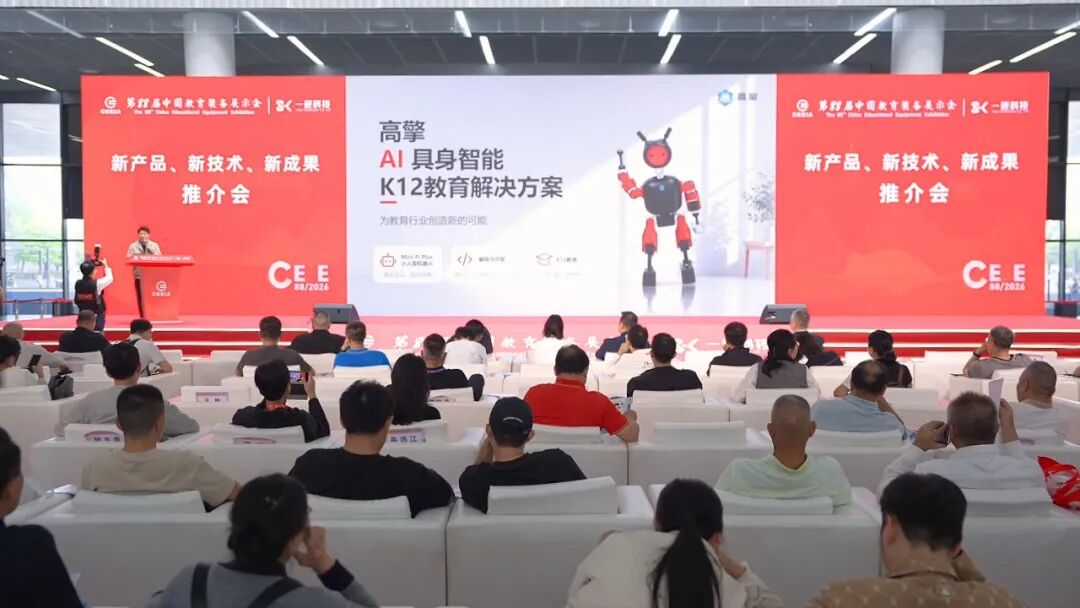
High Torque Robotics at booth E3044, the 88th China Educational Equipment Exhibition
Artificial intelligence is moving from text generated on a screen toward the physical world, where it perceives its surroundings and controls devices. The humanoid robot is AI’s body in that world. As AI education spreads, schools run into a practical bottleneck: hardware is easy to buy, but keeping a course running with the right supporting resources is a long-term problem. Working from the humanoid platform, High Torque has built a complete embodied-intelligence education solution that lowers the entry barrier, fits into daily teaching, and creates educational value.
Lightweight and Capable: A Complete System That Keeps Courses Running
The hard part of bringing robot education into schools is not whether a robot exists. It is whether the equipment fits an ordinary classroom, whether its functions can carry the curriculum, whether courses and teachers can be sustained, and whether students have somewhere to apply what they learn. High Torque’s answer combines lightweight, high-performance hardware, an open software platform, a curriculum and teacher-training system, and competition pathways — lowering the threshold for a school to start a course and to keep it running.
Equipment and capability are the first threshold. Mini Pi Plus balances light weight with high motion performance, which suits campus classrooms and reduces pressure on space and deployment. On the software side, open development interfaces work with mainstream programming tools, intelligent perception, and large-model capabilities, so students can take on real engineering problems that span environment, motion, and structure.
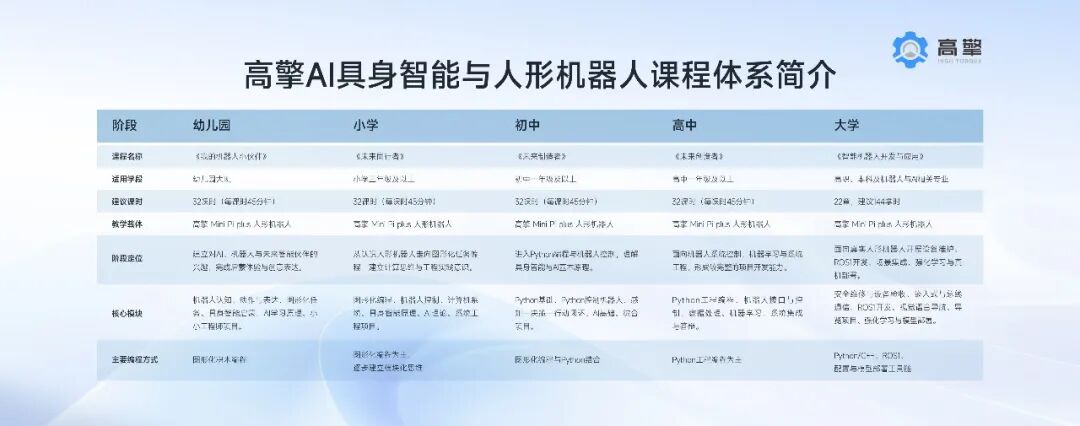
The High Torque embodied-intelligence curriculum system
Teaching support decides how long a course lasts. What High Torque provides is a curriculum system that keeps running: layered lesson plans for every stage of schooling, project task packs, a teaching platform and tutoring resources, and teacher training. Together they connect classroom teaching, club practice, and competition, easing the shortage of course materials and teaching experience so that a course can be sustained over time.
The system is already running as a regular course at schools including RDFZ and Dongzhimen High School, and High Torque worked with CCTV to bring robots to Liangshan Prefecture, serving mountain-area primary schools through technology-assisted teaching. Beyond the classroom, the company provided teaching and technical support to schools such as Tsinghua University High School Changping and Beanstalk International Bilingual School Huairou during the World Humanoid Robot Games, while its ecosystem teams took multiple regional titles and an international runner-up place at RoboCup.
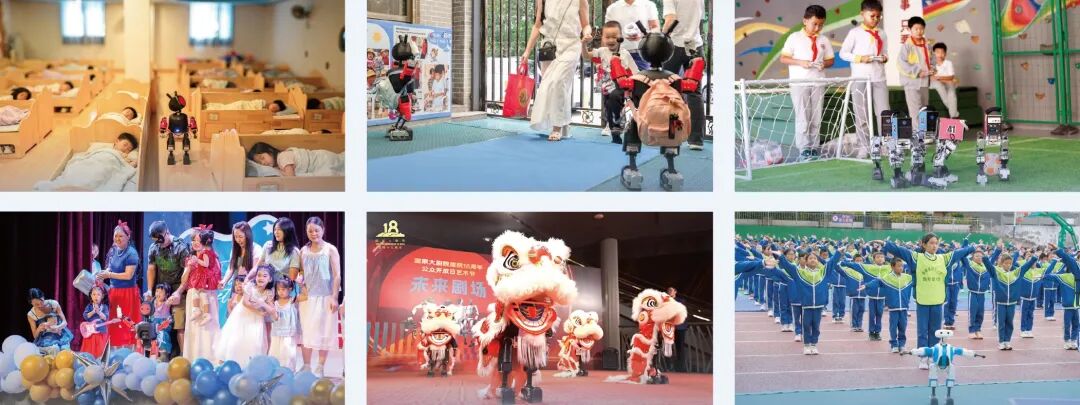
High Torque robots in schools across China
Education First: Technology That Serves the Classroom
Technology is a means; education is the end. In practice, High Torque follows a single thread — continuity across every stage of schooling, one core line of development, and multiple paths for students to grow — and turns hardware capability into classroom tasks suited to different ages.
At the exhibition the company moved a real classroom onto its stand. In the graphical programming area, students drag blocks to send commands and watch the robot respond in real time; the kindergarten session uses visual perception, imitation, and game-based interaction to build logical thinking.
A single robot can cover daily lessons, club activities, and competition showcases — so that technology serves teaching, rather than teaching bending to fit technology.
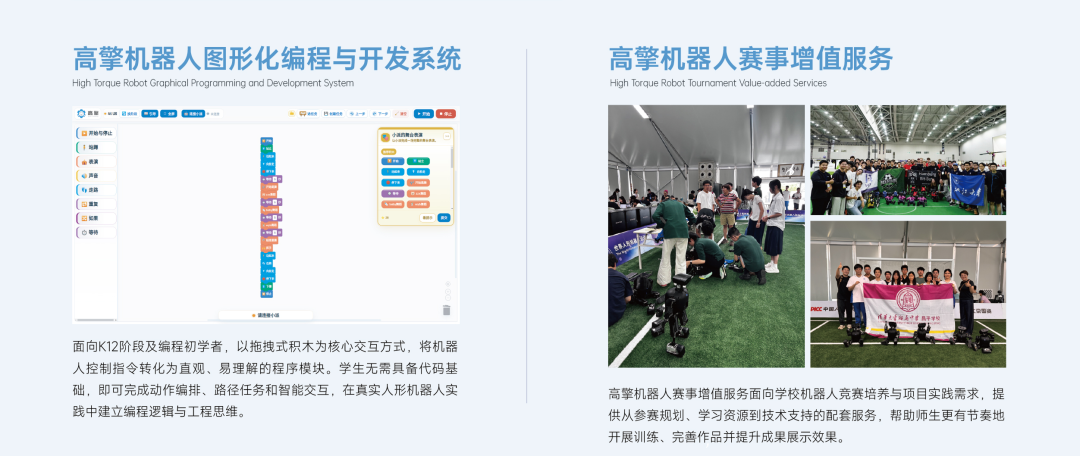
Live interaction at the booth; graphical programming and competition services
Embodiment Takes AI Off the Screen and Extends Education
Under the 15th Five-Year Plan’s drive for digital education, the “AI + Education” Action Plan sets out to advance AI education across every stage of schooling and to bring intelligent technology into all elements and scenarios of education.
Embodied intelligence keeps extending the boundary of AI education, building a bridge to real engineering and physical scenarios. An embodied classroom takes a humanoid robot project as its carrier: students work along the perceive–decide–act loop, debugging and building, turning code on a screen into real motion and real feedback. In doing so they develop interdisciplinary engineering thinking and convert abstract knowledge into visible capability.
The value of educational equipment is to become, in the everyday life of a classroom, a learning partner that students can debug by hand and grow alongside. Giving AI a body, so that every child can learn technology on a real robot — that is the new possibility High Torque Robotics offers to education.
 Form submitted successfully!
 Form submission failed!
 Phone:400-6080-891
 Email:service@hightorque.cn
 Wechat:GQJD2022