Recently, the research paper
Mini Pi plus: A Compact Modular Humanoid Platform for Onboard Whole-Body Learning and Deployment by the High Torque team has been accepted by the WCBM Workshop at
Robotics: Science and Systems (RSS) 2026, a top-tier international academic conference in the robotics field.
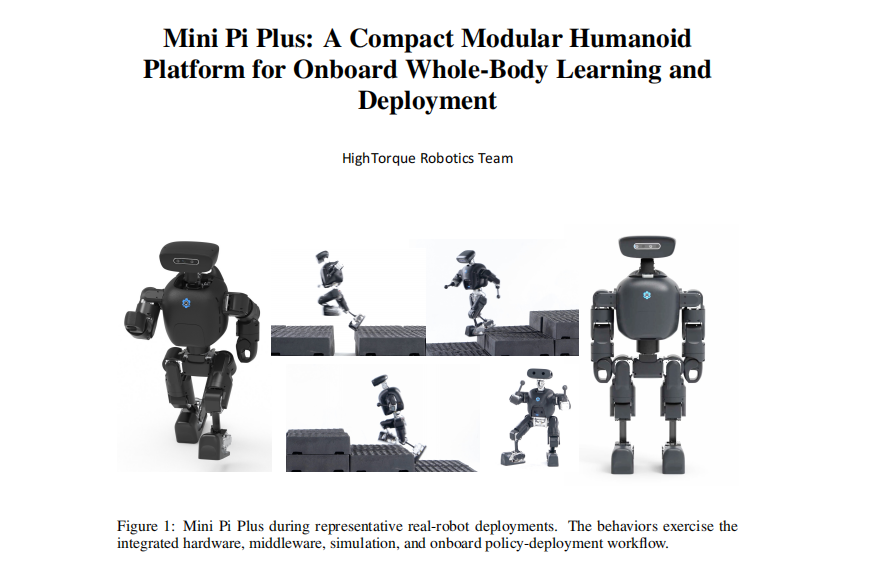
Unlike conventional single-point algorithm innovations, this work represents a platform-level systemic study that addresses a core infrastructure pain point in embodied intelligence: Full-sized humanoid robots come with high costs, strict site requirements and operational risks, making high-frequency iteration unaffordable for most laboratories. Meanwhile, small humanoid platforms generally suffer from insufficient productization, incomplete development resources, closed architectures and a wide sim-to-real gap, resulting in low research validation efficiency and preventing numerous algorithm studies from being deployed on real hardware.
With an integrated design spanning mechanics, electronics, communication and software, High Torque delivers full-body control capability and a standardized end-to-end deployment workflow in a compact form factor, providing a complete, reusable foundation for algorithm research and engineering deployment of small humanoid robots.
Humanoid robot research has long been trapped in a dilemma. While full-sized platforms deliver strong dynamic performance, they carry high unit costs, large footprints, heavy operation and maintenance burdens and elevated safety risks. Small platforms, by contrast, are portable and safe, but typically come with reduced degrees of freedom (DoF), limited on-board computing power and perception capabilities — making them unable to support full-body control and real-world task execution.
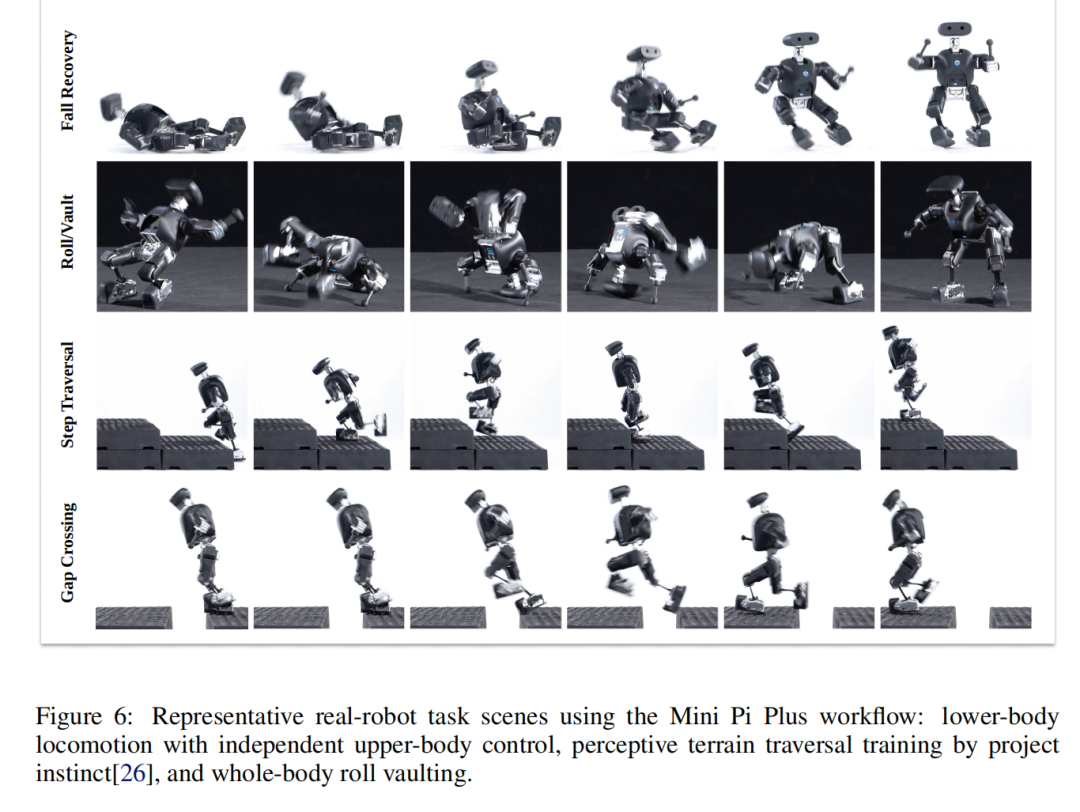
The core breakthrough of Mini Pi plus lies in retaining all system capabilities required for full-body humanoid research within its compact body.
The high-specification Mini Pi plus features 12 leg DoF, 8 arm DoF, 1 waist rotation DoF, 2 head pitch DoF and 4 gripper DoF. Within its limited height, it delivers complete motion capabilities ranging from lower-limb locomotion and upper-limb manipulation to head perception and waist posture adjustment.
Weighing less than 15 kg, the robot can be carried and operated by a single person, greatly lowering the safety threshold for experiments. Combined with its high cost-effectiveness, it truly enables high-frequency, large-scale desktop humanoid robot research.
The paper systematically presents the full-stack design of Mini Pi plus from hardware architecture to software stack, with differentiated technical advantages reflected in four dimensions — each targeting the common shortcomings of existing small platforms.
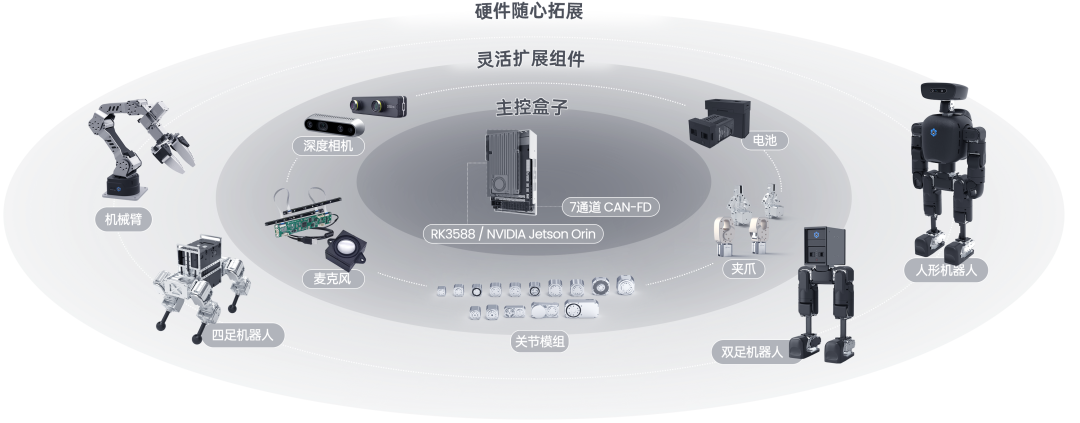
Built on the proven foundation of the first-generation 12-DoF Mini Pi biped robot, the modularity of Mini Pi plus goes far beyond simply attaching upper limbs. High Torque has integrated modular thinking across all layers: mechanics, electronics, communication, software description and deployment configuration.
All limb modules share unified drive protocols, connector specifications and communication conventions.
Configuration switching from the 22-DoF spherical hand version to the 27-DoF version only requires modifying configuration files, with no need to rebuild the underlying system.
Mechanical boundaries, communication branches and software nodes are fully aligned, enabling thorough system decoupling and exponentially improving maintenance and iteration efficiency.
This cross-layer aligned modular design represents a system-level capability absent from most "assembled" small humanoid platforms in the industry.
Communication architecture is the most overlooked yet decisive core component that defines the upper limit of small robot systems.
Mini Pi plus adopts an industry-rare 7-channel independent CAN FD bus architecture, with separate channels for the left arm, right arm, left leg, right leg, waist, head and expansion interface. A single channel supports 10 motors with response within 1ms, and the theoretical full-system capacity supports 70 motors at a 1kHz update rate.
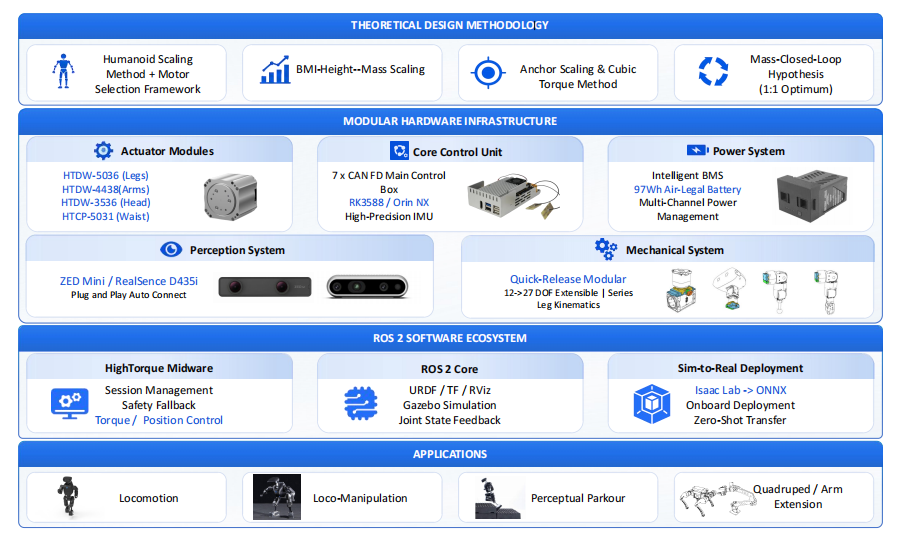
The multi-channel independent design enables channel-level fault isolation: anomalies in a single limb will not spread to the entire system, and each module has clear communication boundaries, providing a highly reliable, low-latency communication foundation for full-body control algorithms. This configuration represents a top-tier specification among humanoid platforms of the same size.
This bus architecture also serves as the unified communication backbone of High Torque’s modular product ecosystem. Products ranging from core control units and standardized joint modules to robotic arms and biped platforms all adopt the CAN FD communication protocol and branch management logic. As the most integrated form in this ecosystem, the full-body Mini Pi plus humanoid covers all limb modules across its 7 channels. It not only validates the bus architecture’s adaptability across scenarios — from individual components to full-body systems — but also enables rapid reuse and seamless migration of technical accumulation across different product lines.
The sim-to-real transfer gap is a core pain point for research efficiency. The Mini Pi plus platform addresses this challenge simultaneously from both underlying modeling and toolchain perspectives.
First, precise calibration of motor parameters via system identification fully replicates the output characteristics of real motors into simulation models, narrowing the gap in physical performance at the source.
Second, a standardized training and deployment pipeline covers the entire workflow: simulation modeling, policy training, ONNX export and on-board execution. With unified interfaces and fixed workflows, it greatly reduces manual adaptation costs, delivers fast real-robot experimental feedback and significantly improves research validation efficiency.
This pipeline has already been validated on real robots across multiple tasks including stable walking, terrain traversal and rolling obstacle crossing. Perception tasks can run in a fully on-board closed loop.
Unlike many closed-source, demonstration-only research platforms, Mini Pi plus fully discloses all details of mechanical parameters, electronic architecture, communication protocols, middleware interfaces, simulation assets and deployment specifications. Complemented by complete development documentation and tutorials, it forms a mature resource ecosystem. All developers can replicate the platform’s capabilities based on these materials and conduct their own algorithm innovations on top of it.
Mini Pi plus has now entered mass production and is delivered globally for scientific research, education, algorithm development and scenario validation use cases.
Its acceptance by RSS 2026 WCBM represents mutual validation between engineering practice and academic standards: a mature product system underpins the rigor and reproducibility of the research, while recognition from a top conference further validates the technological foresight and industry value of the platform architecture.
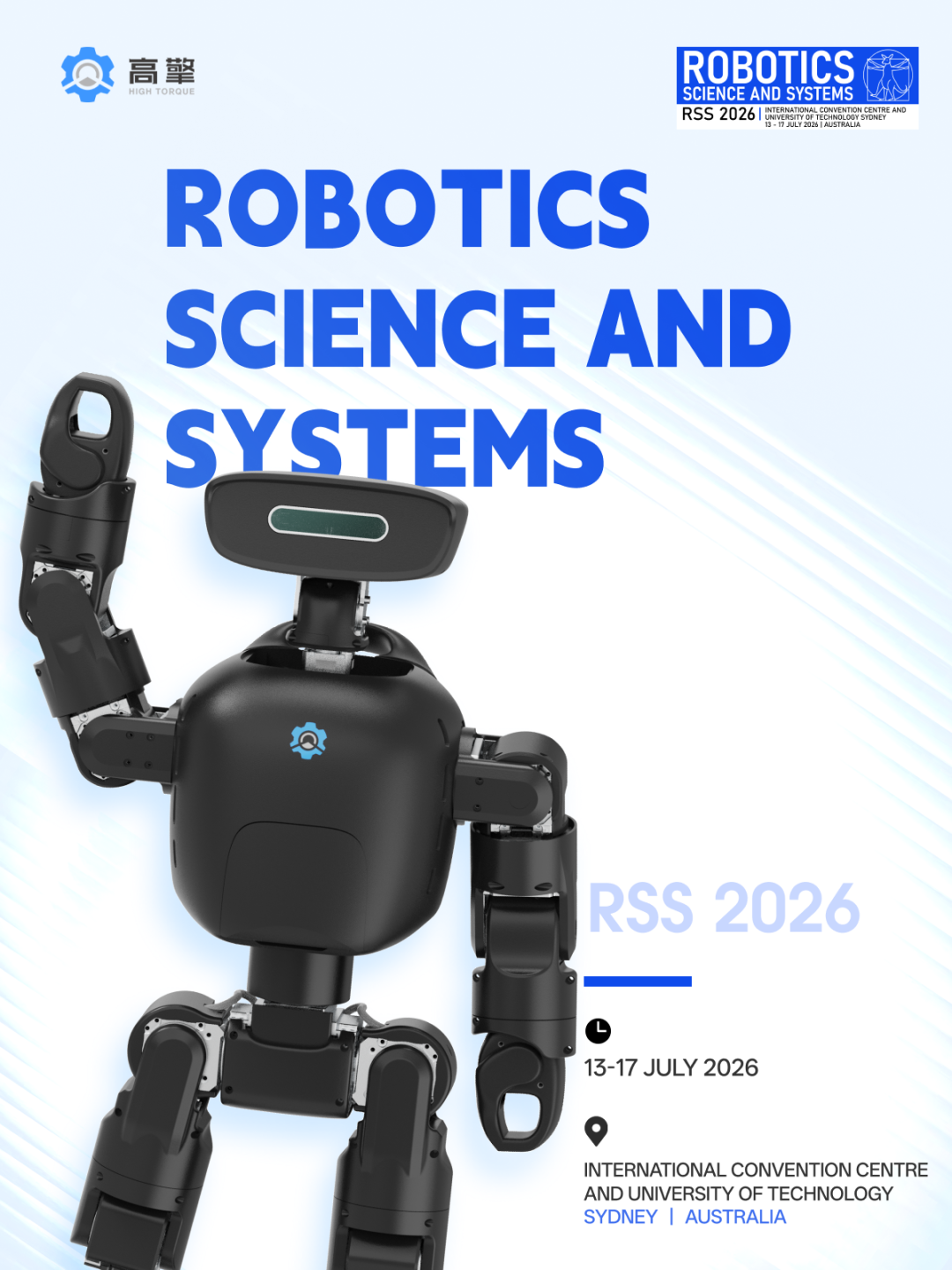
During RSS 2026, the High Torque technical team will attend the conference and showcase the Mini Pi plus robot on site, presenting full technical details and deployment outcomes of the platform from hardware design to full-stack deployment. Global researchers and industry partners attending the conference are welcome to visit and exchange ideas on the cutting-edge directions of small humanoid robots and embodied intelligence infrastructure.
Mini Pi plus is now available for order. For business inquiries, please contact us at: 📧 business@hightorquerobotics.com

 Form submitted successfully!
 Form submission failed!
 Phone:400-6080-891
  Email:service@hightorque.cn
  Wechat:GQJD2022